“Baba Yaga in Popular Culture” TV Tropes
Forrester, Goscilo, Skoro, Zipes, Forrester, Sibelan E. S., Goscilo, Helena, and Zipes, Jack. Baba Yaga : The wild witch of the East in Russian fairy tales. Jackson : UP of Mississippi Jackson, 2013. Print.
Hubbs, Joanna. Mother Russia: The Feminine Myth in Russian Culture. Indiana University Press, 1993. Print.
Johns, Andreas. Baba Yaga : The Ambiguous Mother and Witch of the Russian folktale. New York: New York : Peter Lang, 2004. Print.
“Little Bear’s Son.” Little Bear’s Son. Simon Phipp’s Glorantha. 2 Apr. 2000
Pilkington, A. G., & Pilkington, O. A. (2009). Fairy Tales Of The Russians And Other Slavs. Forest Tsar Press.
Staines, Rima, “Drawing the Old Woman in the Woods.” Marvels & Tales, vol 24, no. 2, Nov. 2010, pp. 336 – 340
Yegorov, Oleg. “Russian Boogeymen: How Did Parents Scare Their Children?” Russia Beyond. 14 June 201.
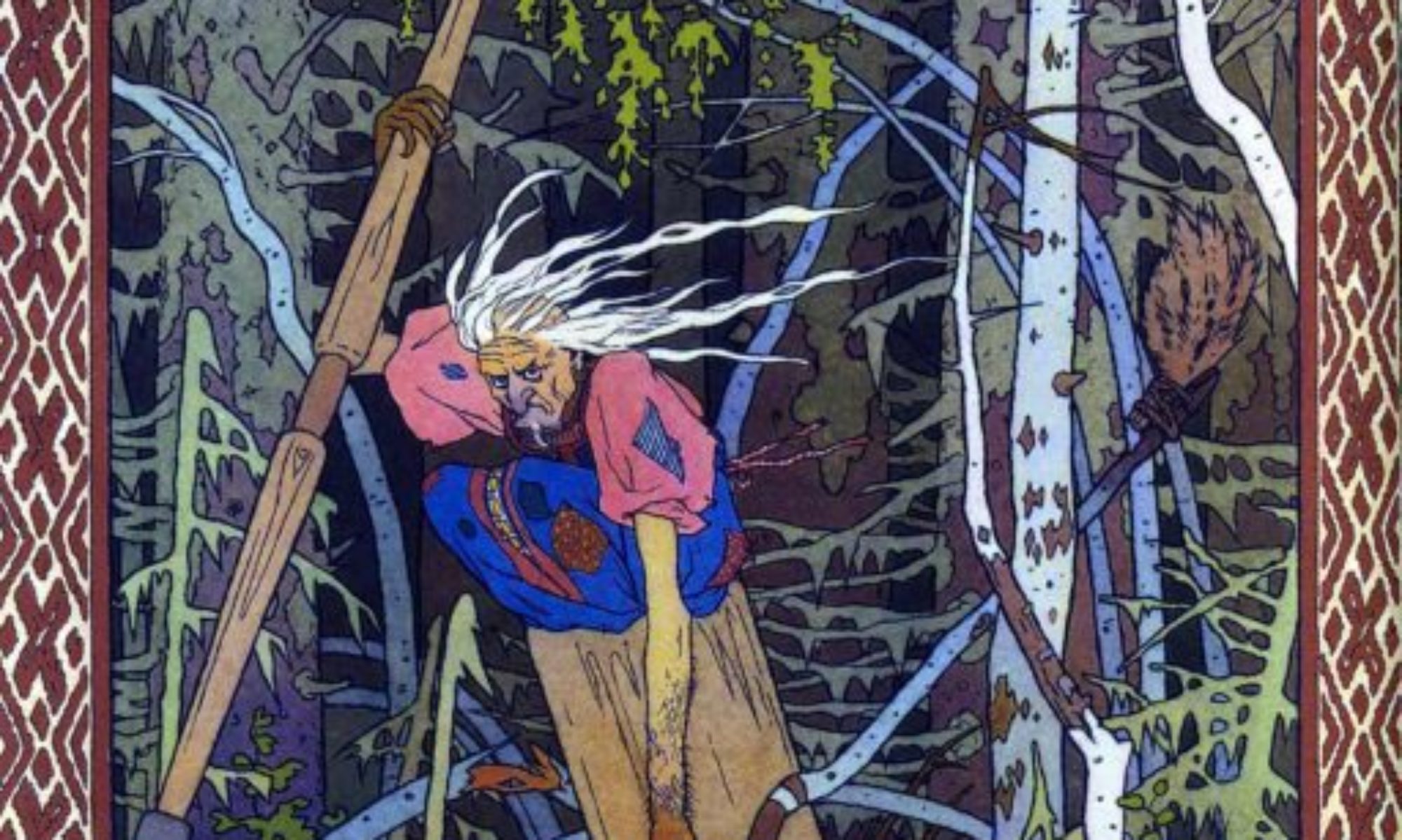
 Like the witches of other cultures, her preferred method of transportation is an implement commonly used for household labor, though unlike the witches of the West, rather than traveling upon a broom, she chooses to ride in a mortar, rowing with a pestle, and using a broom to sweep away the tracks that she leaves. Her mode of transportation itself offers symbolism. “Mortar and pestle are the instruments of destruction and of nurture and protection (clothing). In their symbolic form, they represent the human sexual organs, womb and phallus. Birth, generation, nurture and death are all conjoined here” (Hubbs 39). It is used not only to grind grain but also to prepare the flax which women use in spinning cloth (Hubbs 39) which holds a large feminine aspect.
 “Baba Yaga,” mostly used in Eastern Slavic languages, has a variety of meanings. Baba in Old Russian can be translated most commonly to “old woman” or “grandmother” (Johns 40).