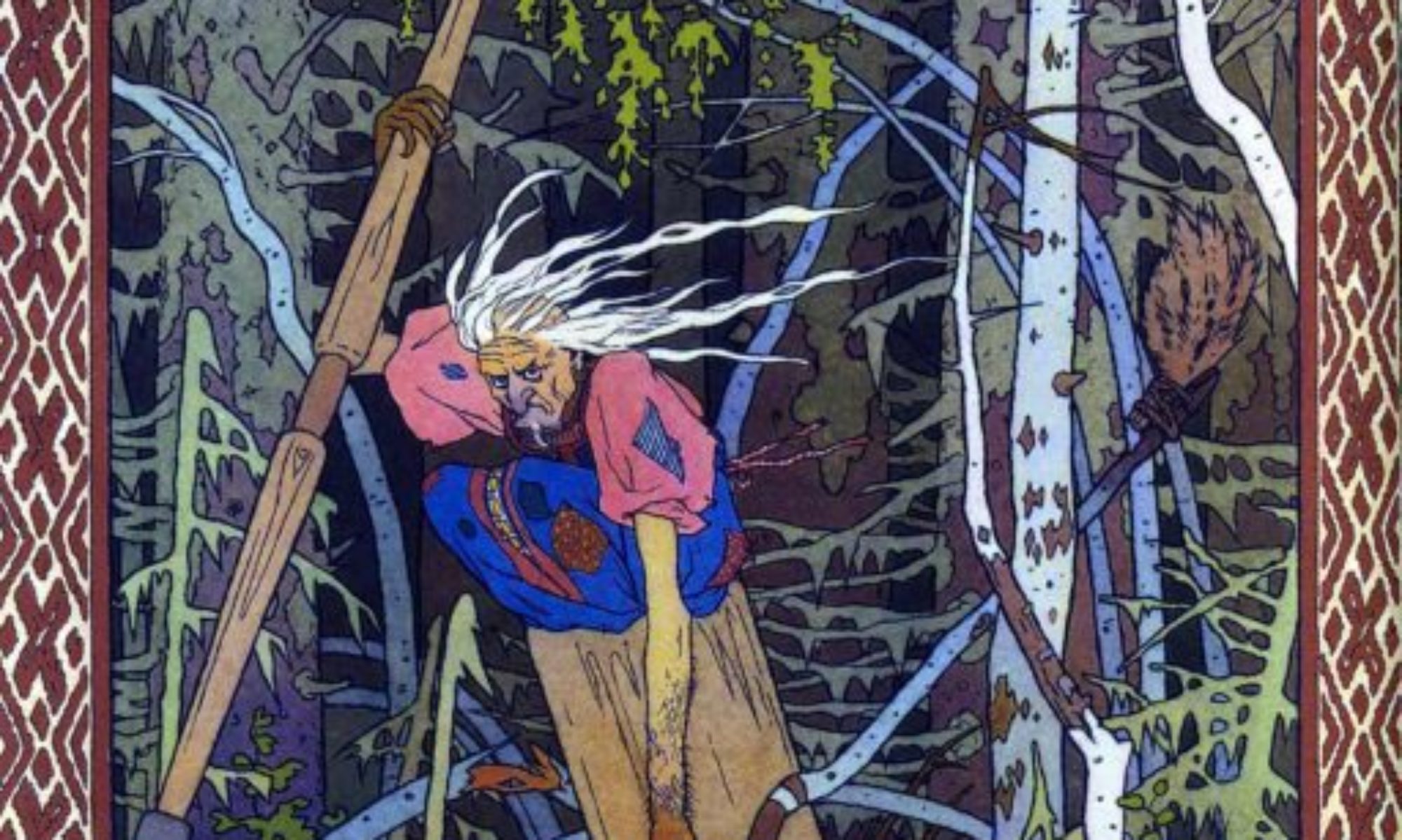
Baba Yaga lives in a hut, which encapsulates ample meaning and serves as a transitioning stage in much of folklore. Young boys and girls encounter her hut on their quests and here Baba Yaga serves in a marginal position between the world of living and the otherworld as either a helper or a challenger.
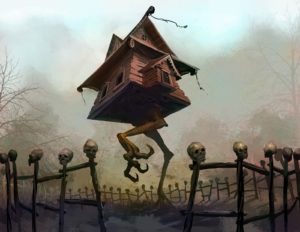
Baba Yaga’s hut is most commonly illustrated standing on top of chicken legs, surrounded by a fence adorned with skulls and placed deep inside the forest. The forest also symbolizes the otherworld, the “land of the living dead,” also known as “the thrice-nine kingdom” (Hubbs 1993). This land is separate from her realm and the boundary that separates the two is frequently symbolized by a river of fire which she cannot cross — though the hero or heroine often must. Vladimir Propp hypothesized the relationship between Baba Yaga’s hut and the zoomorphic izbushkii, or initiation huts, where those who dared to venture near were symbolically “consumed” by the monster, only to emerge later as adults
The center of Baba Yaga’s hut is called the pech’, a place of feeding or sacrifice.
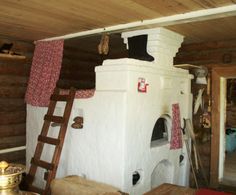
When the pech’ is not in use, Baba Yaga sleeps here and fills the entirety of her hut with her whole body, “…corner to corner, her lips on the cross piece, her nose to the loft” (Pilkington 183). This represents the shielding of the dead while the oven represents the creation of new souls (Hubbs 46).
Her hut is often described spinning and moving about throughout the forrest. The spinning or rotating hut can be seen as the different phases of the moon and Baba Yaga’s interpretation as an “Earth Goddess”. Depending on the manner in which she is approached, Baba Yaga is portrayed as good or evil. Perhaps the crescent moon represents the maiden, a full moon represents a mother figure, and the crone represents the dark or evil phase (Gilchrist 101). “…the moon is full, the opening point to the west, and the charnel hut is accessible to the living. The Yaga who sits in the house is like the full moon, pregnant and healthy. But when the night skies show only a crescent like the horns of a headless sacrificed bull, Yaga no longer lives in the hut. It is empty as her barren belly. The waxing and waning moon not only refers to the full and empty hut-belly of the witch; it stands for Baba Yaga’s transformation from the lovely spinner Vasilisa the Wise to the decrepit hag with a withered leg representing the dying crescent”